


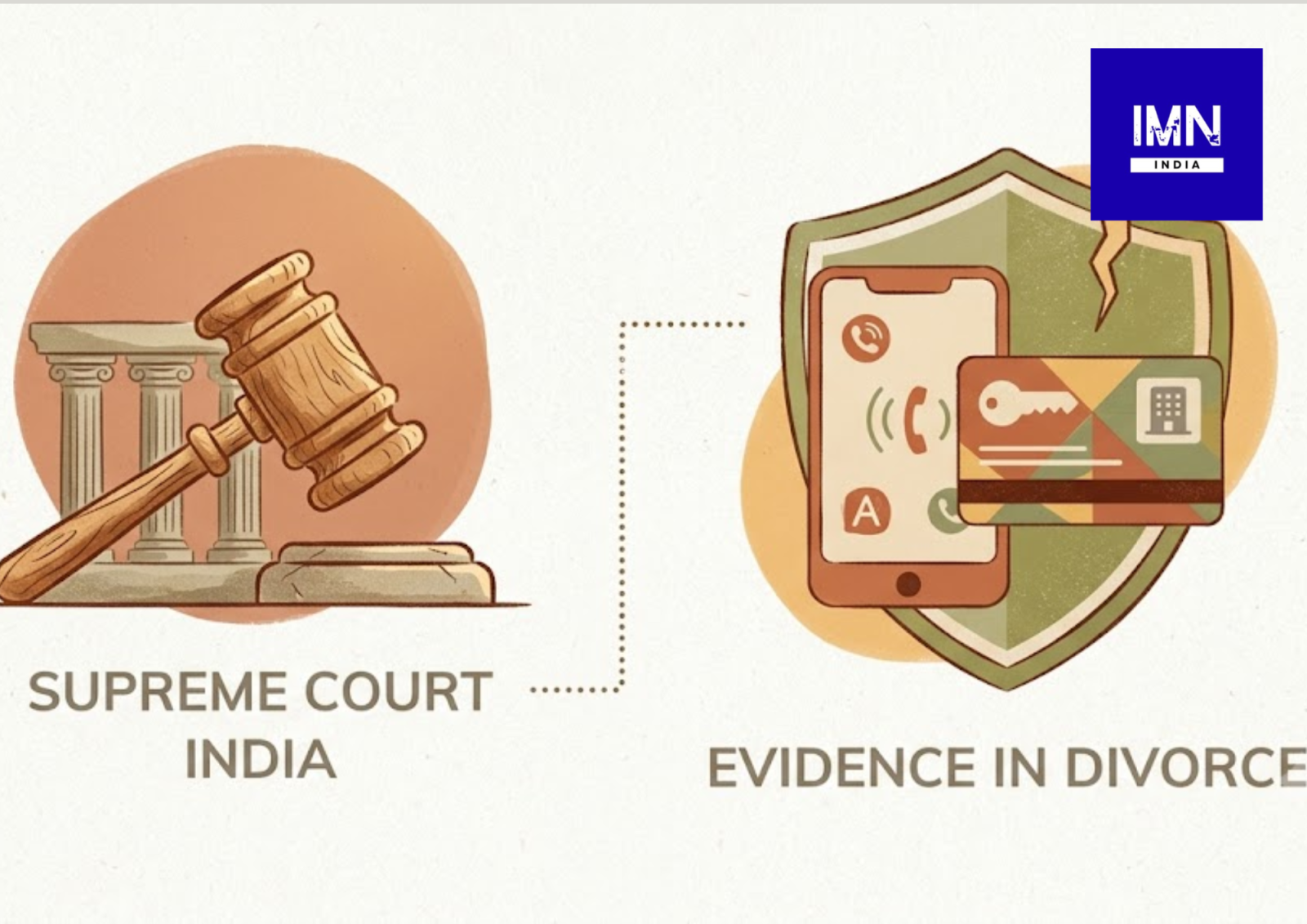
The Supreme Court has ruled that hotel booking records and mobile Call Detail Records (CDRs) can be summoned in matrimonial disputes to examine allegations of adultery, holding that the constitutional right to privacy cannot be used as an absolute shield against the production of relevant evidence in court. The landmark ruling came while the apex court dismissed an appeal challenging an earlier judgment of the Delhi High Court, reinforcing the principle that a fair trial may require access to documentary and electronic evidence.
The case arose from a divorce petition filed under the Hindu Marriage Act, in which a woman alleged that her husband was involved in an extramarital relationship. To substantiate her claims, she sought access to the husband’s hotel booking records, payment details, identity documents linked to hotel stays and his mobile call detail records. According to the petitioner, these documents were essential to establish the circumstances surrounding the alleged relationship and assist the Family Court in arriving at a just conclusion.
Supreme Court Balances Privacy with Fair Trial
The husband opposed the request, arguing that the disclosure of such records would violate his fundamental right to privacy guaranteed under Article 21 of the Constitution. He further contended that producing the records would also infringe upon the privacy rights of the woman allegedly involved in the relationship and her minor daughter.
However, the Supreme Court refused to interfere with the Delhi High Court’s order. The bench observed that although the right to privacy is a constitutionally protected right, it is not absolute and is subject to reasonable restrictions in appropriate judicial proceedings. The court held that where a spouse seeks relevant evidence to establish allegations of adultery, the production of such records may be permitted if they are necessary for the fair adjudication of the matrimonial dispute.
The apex court also agreed with the High Court’s reasoning that adultery is ordinarily proved through circumstantial evidence rather than direct evidence. It observed that hotel booking records, payment details and call detail records could provide relevant supporting material to assist the Family Court in evaluating the allegations. At the same time, the court clarified that directing the production of these documents does not amount to proof of adultery but merely enables the judicial process to examine all relevant facts before reaching a conclusion.
Hotel Records and CDRs May Strengthen Matrimonial Evidence
The judgment further noted that the Family Court had limited its direction to records relating only to the husband and had not ordered unnecessary disclosure of personal information concerning unrelated individuals. As a result, the Supreme Court found no legal infirmity in the High Court’s decision permitting the production of the requested records.
The ruling is expected to have significant implications for matrimonial litigation across the country. Family Courts often rely on documentary and electronic evidence while deciding divorce petitions involving allegations such as adultery, cruelty and desertion. The judgment clarifies that courts can summon relevant records when they are necessary to determine the truth and ensure justice between the parties.
The Supreme Court’s observations also reaffirm the principle laid down in earlier constitutional rulings that the right to privacy, though fundamental, is not unlimited and may be balanced against competing legal interests such as the administration of justice, due process and the right to a fair trial.
Background: Privacy Rights and Matrimonial Litigation
The constitutional right to privacy was recognised as a fundamental right by a nine-judge Constitution Bench of the Supreme Court in the landmark K.S. Puttaswamy judgment in 2017. However, the court also clarified that privacy is subject to reasonable restrictions where a legitimate state interest or judicial process requires disclosure. The latest ruling builds on that principle by recognising that relevant evidence may be summoned in matrimonial proceedings when necessary for a fair and effective adjudication.
Legal experts believe the verdict will serve as an important precedent in future matrimonial disputes involving electronic records and documentary evidence. While the ruling strengthens the ability of courts to examine relevant material, it also underscores that privacy rights must be carefully balanced to deliver justice in individual cases. The judgment is expected to guide Family Courts across India in dealing with similar requests for evidence in divorce and matrimonial proceedings.
Follow for more updates: www.instagram.com/imnindia.news/
















Leave a comment