


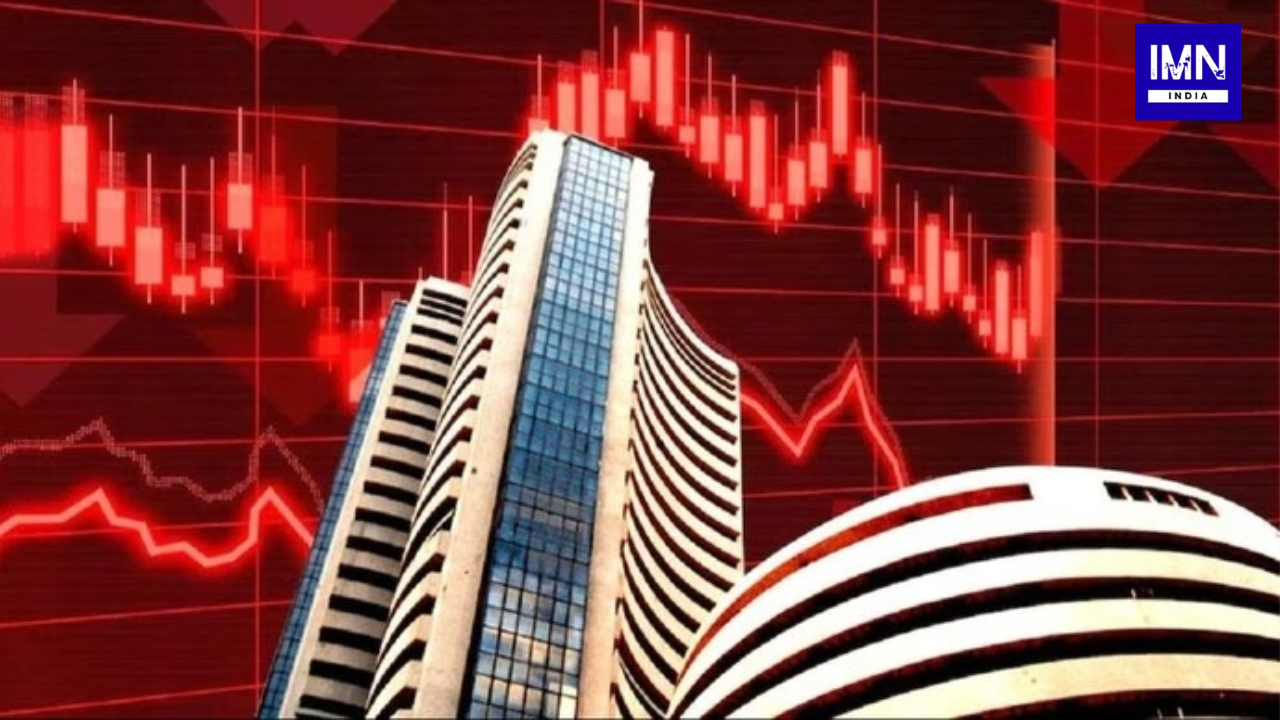
The India Stock Market remained under pressure on Monday as benchmark equity indices closed sharply lower for the fourth consecutive trading session. The BSE Sensex plunged 508 points to settle at 74,267, while the NSE Nifty dropped 165 points to close at 23,383. Weak investor sentiment, profit booking and heavy selling in key sectors dragged the market lower despite a positive start earlier in the day.
The India Stock Market initially opened on a strong note following positive cues from Asian markets. However, selling pressure emerged by midday and intensified during the second half of trading. Analysts said investors remained cautious due to global economic uncertainty, foreign fund outflows and concerns over inflation and interest rates.
Broader markets also witnessed significant weakness during the session. The Nifty Midcap 100 index declined more than 1.4 percent, while the Smallcap 100 index slipped nearly 0.9 percent. Market experts believe the broader decline reflects cautious investor behaviour across sectors.
Among the top losers in the Sensex pack, Hindustan Unilever dropped over 2.8 percent. ITC shares declined more than 2.5 percent, while NTPC lost over 2.1 percent. Investors also sold heavily in power, utilities and capital goods stocks, pushing sectoral indices lower.
However, the IT sector provided some support to the India Stock Market during the session. Tech Mahindra emerged as one of the top gainers by rising around 3.8 percent. Infosys gained 3.7 percent, while Tata Consultancy Services advanced nearly 2 percent. Strong buying in technology stocks came amid expectations of stable global demand for IT services.
Sector-wise performance remained largely negative at the Bombay Stock Exchange. Out of 25 sectoral indices, 21 closed in the red. The Power index fell nearly 2.9 percent, while Capital Goods declined over 2.4 percent. Utility and industrial stocks also remained under pressure throughout the session.
In contrast, IT-related indices registered gains. Focused IT rose more than 2.5 percent, while the overall IT index advanced 2.4 percent. Metal stocks also ended slightly higher due to selective buying in commodity-linked companies.
The overall market breadth clearly reflected weakness in the India Stock Market. Shares of 2,761 companies declined on the BSE, compared to 1,589 advancing stocks. Around 199 shares remained unchanged during the session. Traders said the sharp difference between advancing and declining stocks signals growing nervousness among investors.
Market analysts believe global developments continue to influence investor sentiment in Indian equities. Rising geopolitical tensions, uncertainty in global energy prices and concerns over monetary policy decisions by major central banks have increased volatility across world markets.
Experts also pointed out that foreign institutional investors have remained cautious in emerging markets in recent weeks. This has resulted in intermittent capital outflows from Indian equities, adding pressure on benchmark indices.
Despite short-term volatility, economists remain optimistic about the long-term outlook of the India Stock Market. Strong domestic consumption, government infrastructure spending and improving corporate earnings are expected to support economic growth in the coming quarters.
Investors are now closely watching upcoming economic indicators, corporate earnings updates and global market trends for further direction. Market participants are also expected to monitor foreign investment activity and central bank policy decisions in the coming weeks.
The latest decline in the India Stock Market highlights the fragile nature of investor confidence amid uncertain global conditions. Analysts believe volatility may continue in the near term, though fundamentally strong sectors such as technology and manufacturing could provide stability to the broader market.
Financial advisors have urged retail investors to remain patient and avoid panic selling during periods of correction. Experts say disciplined investing and focus on quality stocks remain crucial during uncertain market phases.
The India Stock Market has now witnessed four consecutive sessions of losses, making investors cautious about near-term trends. However, many analysts believe that temporary corrections are a normal part of market cycles and long-term fundamentals of the Indian economy remain strong.
Also read: India-Oman CEPA Comes Into Force, Gives 100% Duty-Free Access to 99% of Indian Exports
Follow for more updates: www.instagram.com/imnindia.news/














Leave a comment