


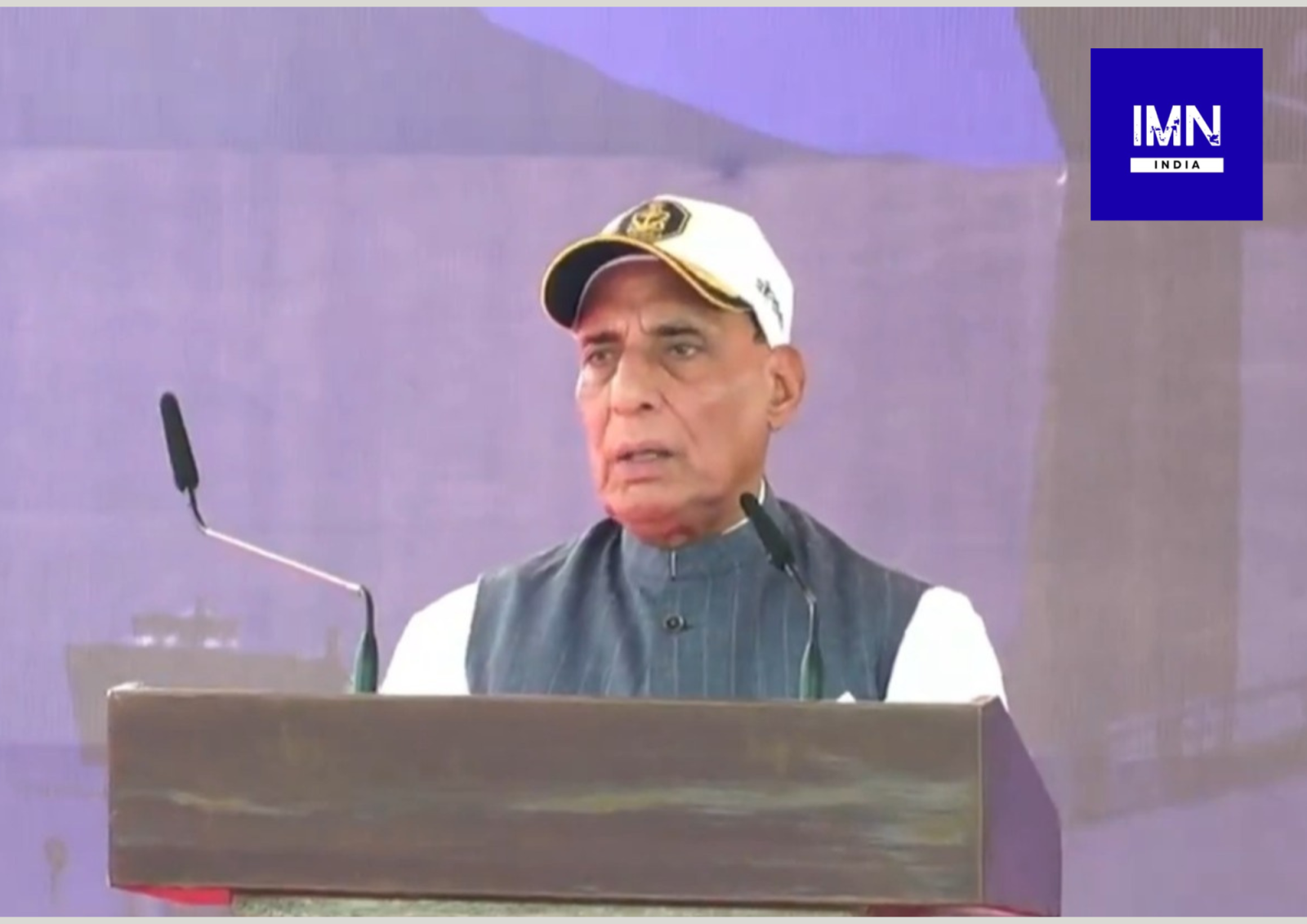
Visakhapatnam: INS Mahendragiri commissioned into the Indian Navy marked another significant milestone in India’s journey towards defence self-reliance, with Defence Minister Rajnath Singh stating that the country is building a strong, self-reliant and future-ready military by strengthening both conventional defence capabilities and advanced technologies. Speaking at the commissioning ceremony of the sixth Project 17A indigenous stealth frigate, Singh said India is preparing its armed forces to meet evolving security challenges while expanding indigenous defence manufacturing.
Addressing naval personnel and defence officials, the Defence Minister said future conflicts may increasingly involve Artificial Intelligence, autonomous systems and other emerging technologies. However, he stressed that wars are ultimately won through national resolve, courageous soldiers and capable military forces. He said technology and conventional military strength complement each other, and India is committed to excelling in both under the vision of Aatmanirbhar Bharat.
INS Mahendragiri Strengthens India’s Maritime Security
The Defence Minister described INS Mahendragiri as a major addition to the Indian Navy’s Eastern Fleet and a symbol of India’s expanding indigenous shipbuilding capability. He noted that more than 75 per cent of the warship has been built using indigenous content, reflecting the growing strength of India’s domestic defence industry.
He said the induction of six frontline warships into the Indian Navy within nearly one and a half years demonstrates the country’s increasing confidence in indigenous manufacturing and the rapid expansion of its defence industrial ecosystem. According to Singh, India has moved steadily from being dependent on defence imports to designing and producing advanced military platforms through domestic innovation and skilled manpower.
Project 17A Warship Equipped with Advanced Indigenous Systems
INS Mahendragiri is equipped with several advanced indigenous and modern weapon systems, including BrahMos supersonic cruise missiles, advanced multifunction radar, integrated air defence systems and sophisticated electronic warfare capabilities. The stealth frigate has been designed to detect and neutralise threats in the air, on the sea surface and underwater, significantly enhancing India’s operational reach across the Indian Ocean Region.
Project 17A is the successor to the Shivalik-class stealth frigates and represents one of India’s most advanced indigenous naval warship programmes. The project aims to provide the Indian Navy with modern multi-role warships capable of operating in high-threat maritime environments while supporting long-range missions.
Operation Sindoor Demonstrated India’s Military Capability
Referring to Operation Sindoor, Rajnath Singh said the Armed Forces successfully demonstrated India’s ability to combine advanced technology with conventional military strength to safeguard national sovereignty. He said the operation sent a strong message that India possesses the capability and determination to protect its national interests against any challenge.
The Defence Minister added that maritime security and economic security have become closely interconnected in today’s global environment. Referring to Prime Minister Narendra Modi’s MAHASAGAR (Mutual and Holistic Advancement for Security and Growth Across Regions) vision, he said India has emerged as a reliable partner and a Net Security Provider across the Indo-Pacific region.
Indian Navy’s Expanding Role Beyond Combat Operations
Highlighting the Navy’s broader responsibilities, Singh said the Indian Navy has consistently acted as the first responder during natural disasters, humanitarian assistance and disaster relief operations, anti-piracy missions and overseas evacuation exercises. He also praised the Navy’s efforts in ensuring the safe movement of merchant vessels carrying critical energy supplies during the recent West Asia conflict.
The Defence Minister further described Visakhapatnam as one of the strongest pillars of India’s maritime strength and said Andhra Pradesh is emerging as a major hub for defence and aerospace manufacturing. He referred to the Advanced Medium Combat Aircraft Core Integration and Flight Testing Centre, Bharat Dynamics Limited’s Dynamic Systems Manufacturing Facility in Anakapalli and the proposed Drone City in Kurnool as major initiatives boosting India’s defence capabilities across air, sea and unmanned systems.
Aatmanirbhar Bharat Driving India’s Defence Manufacturing
Over the past few years, India has significantly increased domestic defence production through initiatives such as positive indigenisation lists, higher defence procurement from Indian companies and increased private sector participation. Indigenous platforms including aircraft carriers, destroyers, missile systems and combat aircraft are now playing an increasingly important role in strengthening the country’s defence preparedness.
Concluding his address, Rajnath Singh expressed confidence that India will emerge as a global hub for shipbuilding and maritime defence manufacturing under the Maritime India 2030 vision. He urged young innovators, startups, researchers and defence industries to contribute to the development of next-generation military technologies, saying every indigenous warship strengthens not only national security but also economic growth, technological innovation and employment generation.
Follow for more updates: www.instagram.com/imnindia.news/
















Leave a comment