


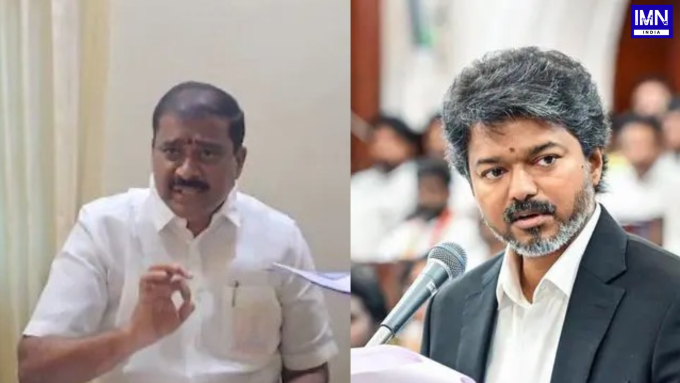
The recent decision by Tamil Nadu Governor Rajendra Vishwanath Arlekar, disallowing Vijay’s TVK (Tamilaga Vettri Kazhagam) from forming the government due to a perceived lack of majority, has ignited a fervent debate across the state’s political landscape. This development, which underscores the rigorous constitutional requirements for assuming power, has drawn keen observations from political analysts and public figures alike. Among the first to weigh in was acclaimed actor and commentator Kasthuri Shankar, whose insights have shed further light on the Governor’s rationale, particularly emphasizing the ‘did not represent’ aspect of the burgeoning political entity.
At the heart of the matter lies Article 164 of the Indian Constitution, which mandates that the Governor appoint the Chief Minister from the party or coalition that commands a clear majority in the Legislative Assembly. For any political outfit, especially a new one like Vijay’s TVK, demonstrating this numerical strength is the paramount first step towards governance. While the exact details of the communication between the Governor’s office and TVK remain under wraps, the core issue, as conveyed, was the absence of sufficient electoral victories or pre-existing alliances to cross the crucial halfway mark in the assembly. This isn’t merely a formality; it’s a foundational principle ensuring stable governance and democratic legitimacy.
Kasthuri Shankar’s remarks resonate deeply within this constitutional framework. Her elucidation that the party ‘did not represent’ a majority goes beyond just a count of seats. It hints at the broader mandate, or lack thereof, that a political entity needs to command from the electorate to be considered a viable contender for state leadership. For a party in its nascent stages, without a proven track record in electoral politics or a wide network of elected representatives, challenging the established order presents an enormous hurdle. The Tamil Nadu political arena, historically dominated by deeply entrenched Dravidian parties, offers little room for error for new entrants, even those backed by immense star power.
The Governor’s role is not merely ceremonial; it involves a careful assessment of political realities to prevent instability. The denial of government formation to Vijay’s TVK highlights the careful scrutiny applied to claims of majority. It necessitates a transparent and verifiable demonstration of support from a sufficient number of elected Members of Legislative Assembly (MLAs) to form a functioning government. Without this, any invitation to form government would be seen as a dereliction of constitutional duty and an invitation to political chaos, potentially leading to immediate no-confidence motions and further instability.
For actor Vijay and his party, the Tamilaga Vettri Kazhagam, this initial setback serves as a stark reminder of the arduous journey ahead in electoral politics. While his cinematic charisma guarantees a massive following, translating that popularity into electoral success and, more crucially, a legislative majority, requires meticulous grassroots organization, alliance-building, and a compelling political agenda. The path taken by other celebrity-turned-politicians in Tamil Nadu, from M.G. Ramachandran to J. Jayalalithaa and even the struggles faced by figures like Kamal Haasan and Rajinikanth, underscores that public adulation alone rarely suffices to dismantle established political structures.
Kasthuri Shankar’s statement implicitly urges a deeper reflection on the mechanisms through which political legitimacy is earned in a democracy. It’s not just about fielding candidates but about ensuring those candidates secure victories that collectively translate into a governing mandate. The Governor’s decision, therefore, is less a personal slight against Vijay or his party, and more a procedural enforcement of democratic principles designed to protect the integrity of the legislative process and ensure the stability of the state government. It reinforces that genuine representation, derived from a clear electoral majority, is non-negotiable.
Moving forward, Vijay’s TVK will undoubtedly need to recalibrate its strategy. This could involve intensified grassroots campaigning, forging strategic alliances with like-minded parties, or focusing on specific issues that resonate deeply with the electorate to build a formidable political base. The incident serves as a crucial early lesson in the harsh realities of Indian electoral politics, where constitutional safeguards and the imperative of majority rule dictate the trajectory of political ambitions, irrespective of individual popularity.
The political discourse in Tamil Nadu remains vibrant, and this episode adds another layer to the complex tapestry of its democratic process. It underscores that while star power can open doors, it is legislative majority and robust representation that ultimately determine who gets to govern













Leave a comment